ATMOsphere America Summit 2026
From Portfolio Data to Project Design: How End Users Are Advancing the Transition to Natural Refrigerants
In June 2026, REEF partnered with ATMOsphere America Summit, the leading event championing natural refrigerants. This summit delivers real-world case studies, policy updates, and market trends for commercial refrigeration and HVAC applications. Amid discussions on health and safety standards with regulatory shifts away from PFAS-laden HFOs, it underscores the business case for clean cooling.
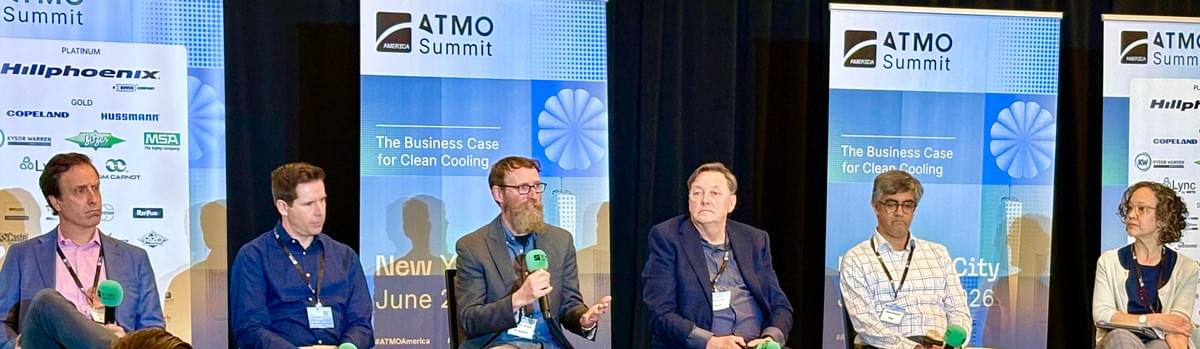
REEF brought HVAC to the forefront of the natural refrigerants conversation through our panel, "From Portfolio Data to Project Design: How End Users Are Advancing the Transition to Natural Refrigerants." The panel featured a remarkable group of building owners, researchers, designers, innovators, and workforce leaders showcasing a growing pipeline of real-world projects shaping the future of HVAC in the United States. From ammonia-based district heating and commercial CO₂ heat pumps to R290 air-to-water systems, workforce training centers, and utility-funded demonstrations, these projects demonstrate that natural refrigerants are no longer a future concept for HVAC, but an emerging market reality.
One theme emerged again and again: interdependence. No single technology, policy, manufacturer, contractor, researcher, or building owner will drive this transition alone. Progress happens when these stakeholders work together—aligning demand, sharing lessons learned, developing the workforce, validating performance, and creating the conditions for scale. We left ATMO inspired by the momentum across the industry and encouraged by the willingness of so many organizations to collaborate in pursuit of practical climate solutions.
HVAC Panel Speakers:
-Umesh Goswami, Principal Environmental Sustainability Manager, Roche
-Curtis S Harrington, Director of Engineering, UC Davis Western Cooling Efficiency Center
-Jonathan Woolley, Owner, Emanant Systems & Co-Founder and CTO, Aris Hydronics
-Michael May, President & CTO, êffecterra
-Cory Palmer, Vice President of Engineering, DMG North
Perhaps the most encouraging takeaway from the panel was that natural refrigerants in HVAC are no longer theoretical—they are being deployed, tested, and scaled today. Roche shared how an ammonia-based heat pump serves approximately 50 buildings at its Basel campus while the company works toward eliminating halogenated refrigerants across its global portfolio. Aris Hydronics highlighted affordable housing projects in Vermont and New York that are bringing R290 air-to-water heat pumps into real-world applications. DMG demonstrated the importance of workforce development through its California Decarbonization Training Center, while UC Davis showcased California Energy Commission-funded research advancing next-generation R290 heat pump technologies. Together, these examples demonstrate meaningful market momentum and reinforce a critical lesson: workforce readiness and contractor training may be just as important as technology innovation.
A huge thank you to the ATMOsphere team, our outstanding panelists, and everyone who contributed their expertise, candor, and enthusiasm throughout the conference. The panel demonstrated that no single technology or pathway will win. Ammonia, CO₂, and R290 are each proving their value in different applications, climates, and building types, reinforcing the importance of a refrigerant-agnostic, performance-focused approach. At the same time, the conversation highlighted the interdependence required to bring these solutions to market. Success depends on building owners creating demand, researchers validating performance, designers solving technical challenges, contractors deploying systems, manufacturers bringing products to market, and trainers preparing the workforce to support them. When these stakeholders work in concert, innovation moves beyond pilot projects and into scalable market transformation. The momentum on display at ATMOsphere suggests that this transition is already underway.
--